


 |
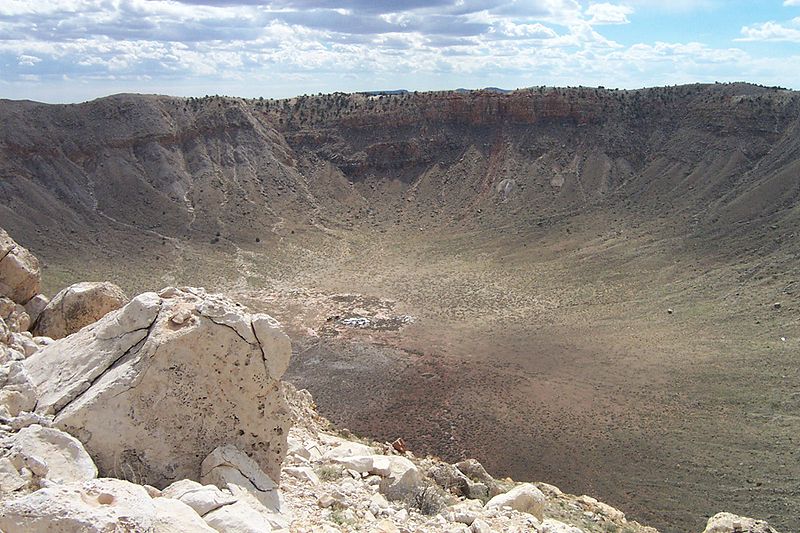
| The Barringer Meteor Crater at Winslow, Arizona. This meteor exploded on impact and left no remains other then fragments behind. As craters go this is relatively small the crater at Sudbury, Ontario was almost 350 miles in diameter and punched through to the earth's mantle. It was later deformed to its present size of approximately 20 X 40 miles. Photo by Deborah Lee Soltesz, USGS |
Although geologists know a vast amount of knowledge about the early earth the relationship between major meteor striks, plate tectonicsand the depositation of gold is completely theoretical. Perhaps we shall never know if this happened during earth’s early history unless we are unfortunate enough for it to occur again now. The reason this has stayed a theory is because it is immensely preferable to the reality of a massive meteor strike.
The last time such an event occurred was the Chixculub event at the end of the Cretaceous over 60 million years ago that wiped out the dinosaurs smashed into the area of the Yucatan Peninsula of Mexico blasting a crater 180 kilometers in diameter, and raising tsunamis estimated to be five miles high. The asteroid causing this event has been estimated to be 60 kilometers in diameter. It has been estimated by geologists it took several seconds to penetrate the earth’s crust. Today the remnants of this crater are buried under several thousand feet of sediments.
Even though plate tectonics are well it understood by geologists the root cause of the phenomena as not very well understood, Vicki Hansen of the University of Minnesota
 |
| An artist's rendition of the Chixulub Event that drove the dinosaurs to extinction By Don Davis/NASA |
Plate tectonics supply two of the heat engines necessary to create mineral deposits, namely regional metamorphism and volcanic or magmatic activity. The third type that has only recently recognized is that caused by a major meteor strike capable of penetrating the earth’s crust. It wasn't until the true nature of the mineral deposits at Sudbury, Ontario was recognized as being caused by a meteor strike that geologists started looking for similar deposits and have discovered that virtually all large impact craters have associated mineral deposit that are predominantly nickel and copper although precious metals are including gold and platinum group metals are found as byproducts.
